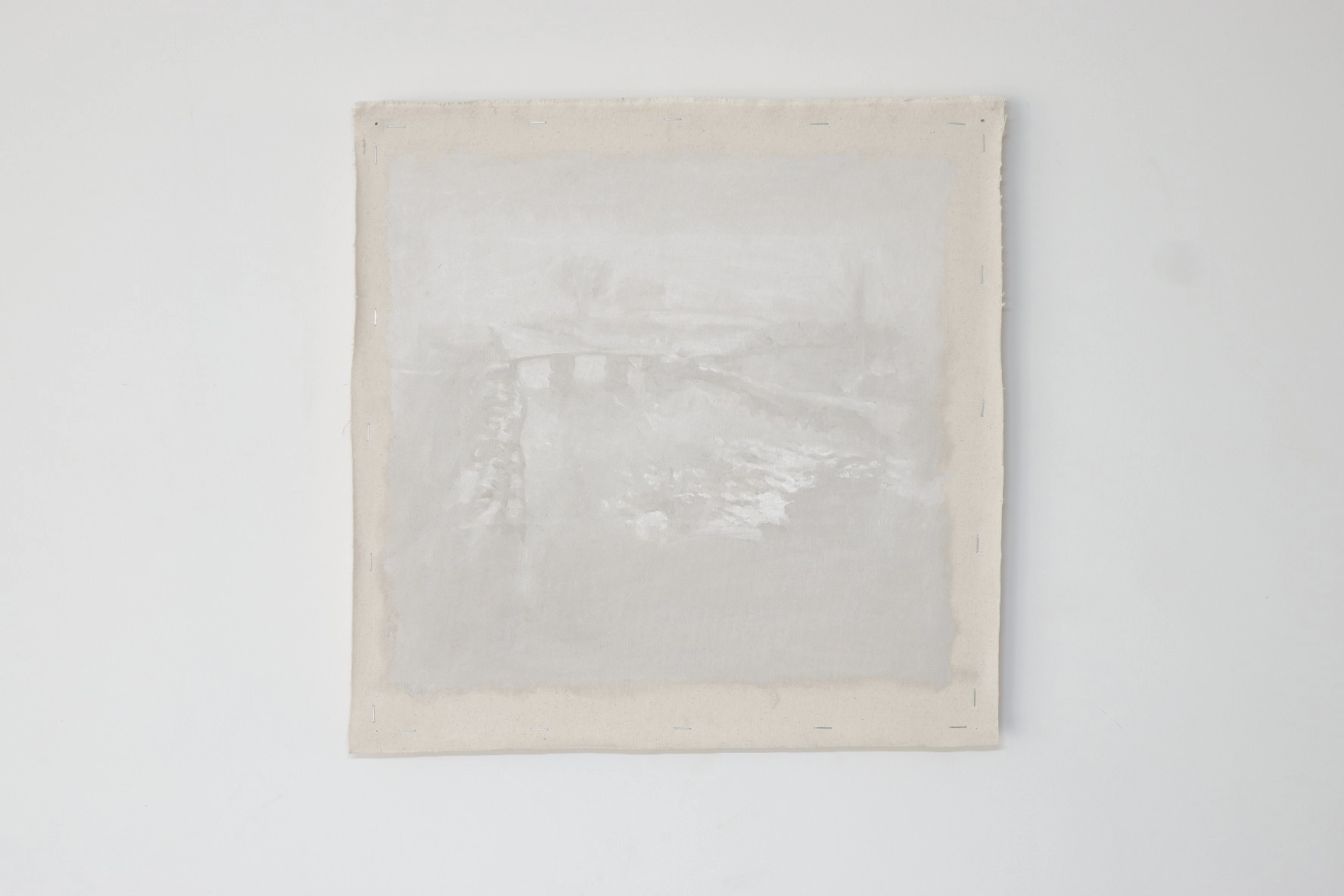
Wherever its geographical location, fog takes shape in the mind. A membrane that negotiates within a system of culture and values; changing not the landscape, but the ability to navigate relationships between objects in the world. Sublimation—matter in transitional states from solid to gas—preoccupies Grace Mitchell’s Fog Lines with greyed-out apparitions of tangible memories. From an archive of photographs, this series of paintings between medium and form shares its uncanny efficacy with fog’s in-betweenness. Landscapes, imbued with waxed substrates and analogous tones recede from precise contours, so that fog becomes the imagination of memory


Objects and landmarks, as they emerge from the fog, are endowed with unresolved meanings of an oblique disconnection, one that parallels the dissociated coordinates of memory. The amalgamations of painting, charcoal, and sculpture draw from the artist’s mother’s ‘anti-photos’ — a facetious aversion her younger self held to photographing ‘touristy’ sites — which combine photographs across England and Italy, circa 1990.
The tether between Mitchell and her mother’s eye is an amorphous, dream-like retracing of steps in facsimile. Rapidly Faded and Fogged up Photograph of a Bridge, 2024, marks the image’s margin with soft, jagged lines, baring the bones of film photography in the same breath as acknowledging its temporal distance from it. In the original referent, green moss swells around the slated bridge, and textured rocks of the bulbous kind occupy the low stream in brown and red. A world, once amused by the self-conscious clichés of a tourist, arrives solemn in Mitchell’s abstraction. The sobriety of grey in varying values sketches in faint bushes and paths, whilst the water under the bridge and the sky in its expanse are suffused and mystified in the isotropic white-out. As crashes of water and the rock barriers which enclose the bridge mingle with natural light, an elusive optical effect jumps out in contrast. As I circle Mitchell’s bridge and ruins, I’m reminded of the tonal objectives of Clarice Beckett’s work. Beckett, an Australian artist, captured natural life with a haziness often mistaken for fog. In The present moment1 at AGSA, Curator Tracey Lock invites us instead to consider the atmospheric haze as a vibration between spaces that allude to an otherworldly place.


Otherworldly sites materialise in the oil painting A Stain and New Veins, 2023 – 2025, where wax creates texture and luminosity to saliva-like strings. Silver coils extend and curl into each other atop a beige and brown stained surface, as if looking at fog from within its membrane. Stains and swatches traverse the image as sublimation scaffolds its desired path, seen also in A Coated Image of Fog, 2023 – 2025, a cotton sheet which billows in even the faintest wind.
The physical condition and content of Fog Lines speak from and of fog’s liminal state. Excess cotton, applied over the paintings, drapes beyond the diptych frames in Very Thick Fog Duo, 2024, so that the paired works appear as damaged surfaces enclosing a threshold of inherited memories. Behind a waxed substrate, a non-objective purgatory of splotches and greyness along its neighbour of gothic arches similarly dissolve into shadows, where semblance proposes a transient, distant location. As the diptych pairs are put aside from their contents’ structural ambitions, to dematerialise stone into ascension, I am remined of Monet’s recount of the fog; its ability to make “grandiose blocks”2 of a place so familiar, suddenly unknown.

120x75cm. Photograph courtesy of the artist.
The ruins made of blocks in Rapidly Faded and Fogged up Photograph of Ruins are similarly cloaked in unknowing. The pillars and fallen stones are simplified into shapes and muted with an opacity that dislocates their historical specificity and reverence. As ruins gather the solid quality of space, I think about how we encounter the past. What significance frames their perseverance? In the mental fog of time, the past is unstable, imposed by personal afflictions and grievances to which they can live once more. We do so well to recognise memory as it’s changed by time, a hazy vibration of sweeping greys.
- https://www.agsa.sa.gov.au/whats-on/exhibitions/clarice-beckett-present-moment/ ↩︎
- “It is the fog that gives it its marvellous breadth. Its regular, massive blocks become grandiose in this mysterious cloak” (Monet, quoted in J. House, ‘Visions of the Thames’, pp. 15-37, Monet’s London: Artists’ Reflections on the Thames 1859-1914, exh.cat., St. Petersburg, FL, 2005, p. 33). ↩︎
Leave a Reply